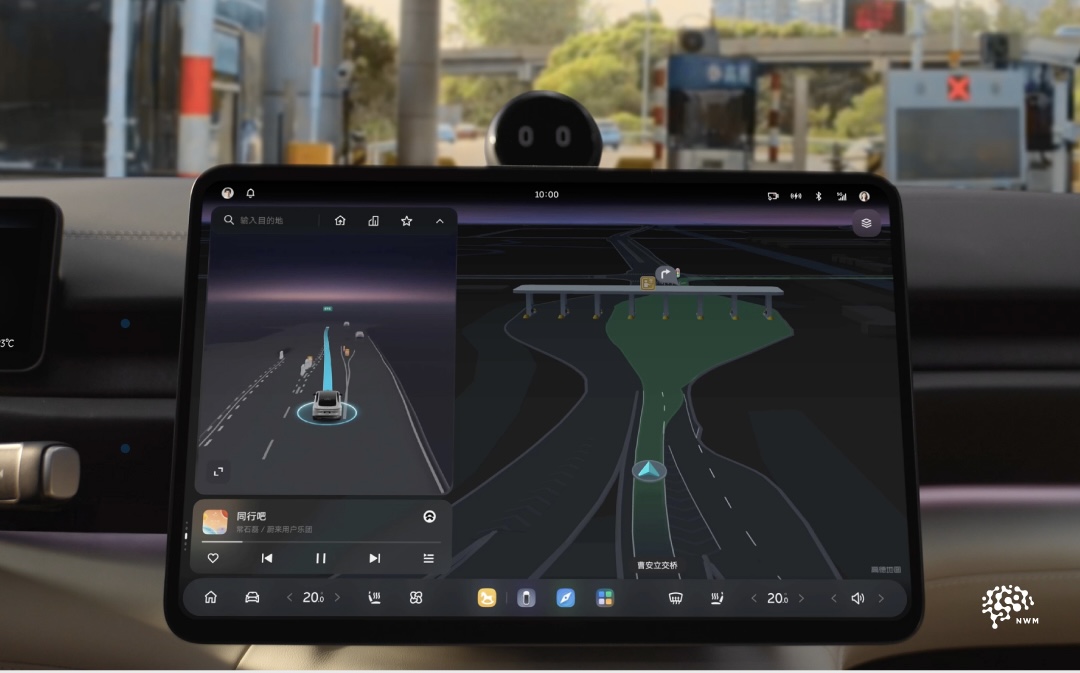
Hello everyone, I’m YongMai;
Opening: A Core Question Affecting Investment Decisions
After publishing my last deep research article on NIO, it sparked considerable discussion. Among them, one focal question that repeatedly appeared—affecting whether investors make short-term trades or long-term investments—was: NIO’s autonomous driving, that mysterious-sounding “World Model NWM,” does it actually “work”? Does it have imagination potential?
This doubt is very reasonable, and it seems there’s also a cognitive gap among many institutional investors. After all, NIO did have a period where its smart driving performance indeed fell behind first-tier progress, causing insufficient user perception of smart driving experience.
Frankly speaking, this question has been lingering in my mind and needs to be clarified again.
Because obviously, if it cannot become a leader in smart driving, it cannot occupy a place in the AI revolution of the physical world, and the imagination space would naturally be much lower.
Currently, the world model has been updated twice, with progress in complex scenario handling and active safety functions. But this still needs more iteration and evolution, and I need to verify and understand its smart driving capability ceiling and technical path again.
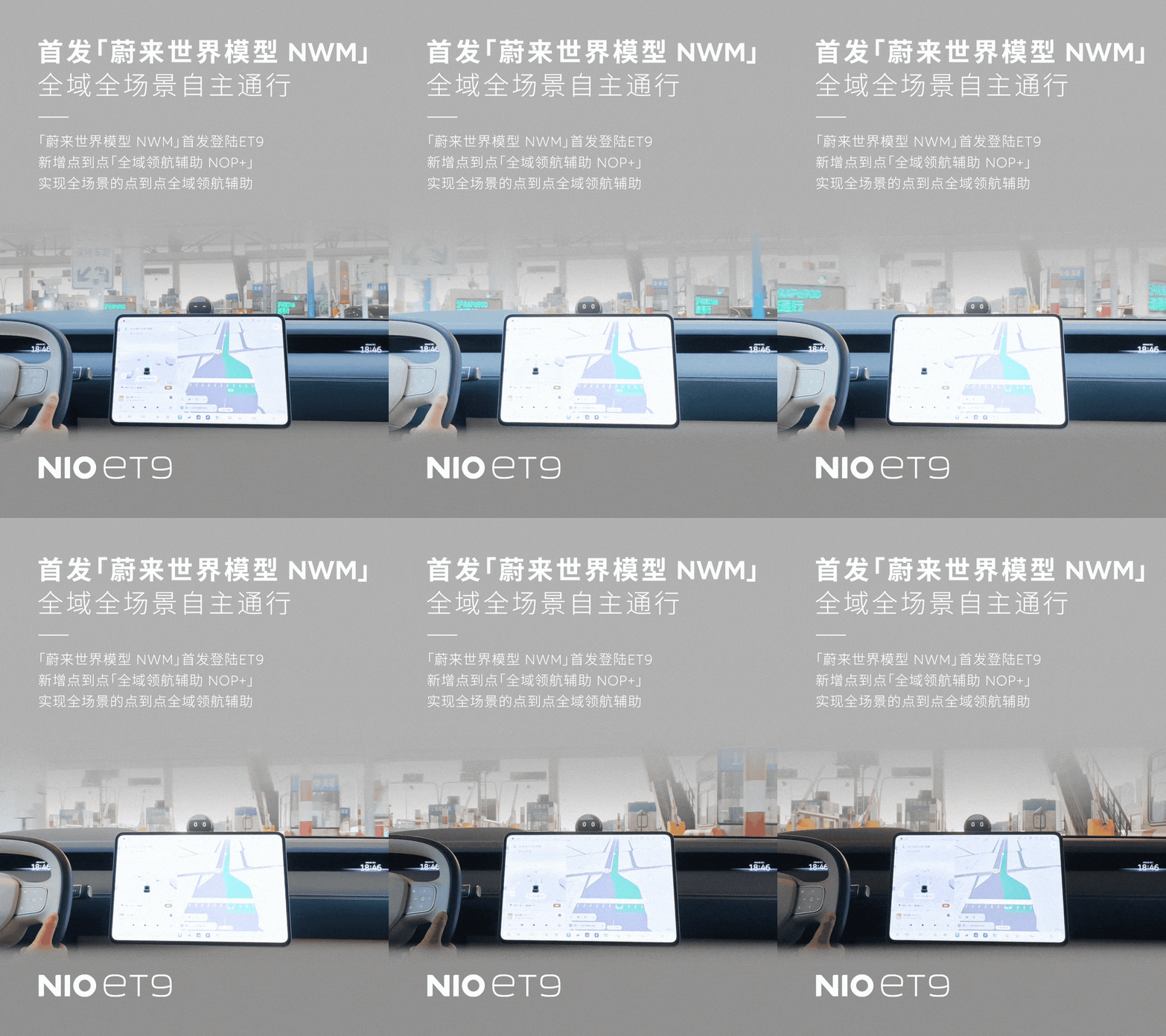
Recently, a video demonstrating NWM capabilities at NIO Day on September 20, 2025, struck like lightning, making me feel it has evolved again while further validating the high ceiling of its technical path.
Impressive Demonstration Scenarios
Several scenarios in the video impressed me:
Scenario 1: The owner gets out of the car in a crowded parking lot and says to NOMI, “Help me park when there’s a spot.” Subsequently, the vehicle autonomously observes, discovers a car about to leave, not only understands but also proactively yields like an experienced driver, waiting for the other party to leave before smoothly parking itself.
Scenario 2: An even more ambiguous command, “Stop in front of that girl in white clothes ahead.” The vehicle precisely identifies and executes.
Is this carefully choreographed “magic,” or a signal that its technical route is undergoing “qualitative change”? To figure this out, I spent some time diving deep into more research. Today, I want to share my exploration process and thoughts with everyone.
Part I: 【Research】Understanding What NWM’s “World Model” Really Is
To avoid getting lost in technical details, I try to understand NWM’s essence from three dimensions: its strategic foundation, fuel system, and technical core.
1. Strategic Foundation: Everything Began with “Excess” Layout Four Years Ago
No castle in the air can last long. The reason NWM can show potential today stems from NIO’s almost “obsessive” long-termism. The core is: begin with the end in mind, hardware first, data-driven, safety-based.
As early as 2021, NIO equipped the NT2 platform with what seemed like “excessive” 4 NVIDIA DRIVE Orin-X chips, totaling 1016 TOPS computing power. This move was highly controversial at the time, but looking back now, it was precisely this “excess” computing power that reserved land for running AI large models like NWM today.
More critically, NIO had forward-looking design from the beginning: among the 4 chips, one was specifically dedicated to collective intelligence, responsible for data collection, annotation, and model training. The subsequent landing of the self-developed 5nm chip “Shenji NX9031” further laid the “foundation” to the “bedrock” level—the new chip not only has stronger computing power but also specifically designed collective intelligence modules, further improving data processing efficiency.
2. Fuel System: Pursuing “Smart Power” Rather Than Pure “Brute Force”
With powerful hardware (engine), efficient fuel is needed. Many people ask, without Tesla’s “data ocean” of millions of vehicles, how does NIO train large models?
This is precisely my biggest cognitive refresh point in this research. NIO pursues not “more” data than Tesla, but achieving more efficient and smarter utilization of computing power through improving quality at the data source + creating data in the cloud.
Refining “Data Gold Mine” at the Source
NIO’s “collective intelligence” system uses surplus computing power at the vehicle end to perform real-time automatic screening and annotation at the data generation source. Specifically, high-quality data generated weekly through collective intelligence equals the data volume of 1,000 traditional road test vehicles in a year. This means what’s transmitted back to the cloud is refined high-value data, not raw “data ocean,” greatly reducing cloud cleaning and training pressure.
Creating “Unlimited Shooting Range” in the Cloud
NIO NWM has “generative simulation” capabilities, able to create millions of virtual but extremely realistic test scenarios in the cloud based on real data. This can efficiently solve long-tail problems (Corner Cases) difficult to encounter in the real world, allowing models to accelerate evolution in an “unlimited shooting range.”
This “smart power” philosophy is key to maintaining competitiveness in the computing power arms race.
3. Technical Core and Ceiling: When Cars Can Understand the World in “Human Language”
This is the fundamental difference between NWM and many driver assistance systems. If traditional solutions are more like using a high-definition camera to “see the world,” then NWM adds a super brain that can “fill in the world” on this basis. It can not only see the present but also “imagine” multiple future possibilities through generative reasoning (reasoning 216 trajectories within 100 milliseconds).
The ceiling of this capability is reflected in the NIO Day demonstration. When the vehicle hears “stop in front of the girl in white clothes,” it completes a leap: it parsed complex “human language,” recognized and locked onto abstract targets in dynamic vision, reasoned out reasonable spatial positions, and converted them into precise driving “actions.”
This is a true VLA (Vision-Language-Action Model) capability demonstration. In my view, NIO’s mass production of “autonomous parking lot navigation” functionality is already a pioneer in industry VLA form applications. The NIO Day demonstration clearly shows the ultimate potential of this route—an intelligent agent capable of deep interaction with the physical world.
Part II: 【Judgment】Route Comparison and My Investment Thinking
Understanding NWM, then looking at the industry landscape, provides clearer judgment.
Comparison of Three Major Technical Paths
Tesla FSD: Core is pure vision end-to-end, relying on massive real-world data “brute force” training, pursuing “replication” of human behavior.
Huawei WEWA: Core is the collaborative architecture of “cloud-based World Engine WE + vehicle-based World Action model WA.” It constructs massive extreme difficult scenarios through generative AI in the cloud and “teaches” AI safety values through safety reinforcement learning; on the vehicle side, it uses native foundation models designed specifically for driving and efficient MoE multi-expert architecture for execution. This is a complete system reconstruction from training to execution.
NIO NWM: Core is world model + VLA, simulating human thinking and decision-making processes through powerful spatiotemporal cognition and generative reasoning, pursuing “understanding” the world.
Potential and Ceiling Analysis
NIO NWM has extremely high theoretical ceiling. The world model + VLA route can better handle long-tail problems and achieve advanced human-machine interaction. As demonstrated at NIO Day, it can achieve stronger autonomous decision-making.
Tesla FSD hopes to achieve “great strength produces miracles” through massive data, reaching general intelligence, but has theoretical bottlenecks in scenarios where pure vision is limited, such as severe weather.
Huawei ADS, under the current technical framework, can achieve extremely high stability and safety in China’s complex road conditions through powerful hardware and engineering capabilities, but the path to higher-order autonomous cognitive intelligence is not yet clear.
My Investment Thinking
NIO chose a difficult but possibly most correct path. It didn’t stop at functional imitation and surpassing but fundamentally reconstructed the algorithmic architecture of autonomous driving. The advanced nature and high ceiling of its technical path determine that it has strong late-mover advantages and huge potential for “overtaking on curves” in future intelligent competition.
The continuous evolution of NWM will be the most hardcore competitiveness supporting NIO in the high-end intelligent electric vehicle market.
PS: Of course, one reason here is that Tesla’s imagination has actually been priced in a lot, with more growth logic ahead, while NIO’s current price hasn’t even priced in smart driving—it’s undervalued even as a car company. So like the current logic of ES8’s 100,000 yuan price reduction being attractive, when the stock price is at a level where you can tell it’s undervalued without precise calculation, I find it hard to remain unmoved.
Part III: 【Inspiration】Re-examining That Deep Research
After understanding NWM’s underlying logic, I also have deeper reflection on my previous research.
【Deep Research】NIO: What “Public” Non-Consensus Secrets Have I Discovered?
Original core viewpoint: “NIO is not a traditional automotive company, but an AI + Hardware + Energy ecosystem company based on world models… It may evolve from an undervalued automotive company into an important technology ecosystem platform company within the next 5-10 years.”
I still maintain this “aggressive” framework. NWM’s potential is precisely the sharpest spear in this framework. But as many friends reminded, grand narratives need realistic support. A mature investor should not only see the stars and sea but also clearly see the ditches underfoot.
1. Rethinking “Apple of Automobiles”
The core of this analogy isn’t about hardware gross margins but about their similar technology self-development and ecosystem construction, brand positioning and premium strategies, user experience and innovation-driven approaches. So I believe, for NIO to break out of the automotive industry’s heavy asset and low gross margin nature, the real way out lies in building a strong software ecosystem, not just relying on automotive hardware.
NWM and SkyOS full-domain operating system are the soul of this ecosystem. When a user pool of millions is formed, AI-based advanced smart driving subscriptions, in-car applications, and even energy network services may bring Apple-style, high-margin, sustainable software revenue.
2. Perspective Shift: From “Short-term Numbers” to “Long-term Capabilities”
Recent data is impressive: ONVO L90 deliveries exceed 10,000 monthly, L60 stable at 5-6,000, Firefly monthly sales 4-5,000, and new NIO ES8 holds roughly 60,000-80,000 locked orders, with production capacity scheduled six months out.
This is certainly gratifying, but I believe what’s more important than these short-term numbers is the validation of capabilities and trends they reflect.
For mature investors, we should focus more on indicators that determine long-term value, rather than getting caught up in chasing short-term delivery and gross margin numbers:
Key Long-term Indicators
Sustainable Competitiveness of New Products: New products based on the NT3.0 platform, whether NIO ES8 or ONVO L90/L60, all show strong market demand. This proves their product definition, marketing, and sales systems are more sophisticated and precise compared to the past. Next, we need to continue observing subsequent models like ONVO L80, ES7, ES9, etc., to verify whether it has systematic capability to create hit products.
Continuous Expansion of User Scale: Under the three-brand strategy, NIO’s total user pool is expanding at unprecedented speed. This not only amortizes R&D and manufacturing costs but is also the foundation for future software ecosystem and energy network value.
Long-term Profitability Trends: No need to overly focus on monthly delivery numbers or quarterly gross margins. We should pay more attention to whether long-term gross margin trends steadily move toward 20% while maintaining high R&D investment; whether new products can still maintain high gross margins after price reductions. This reflects real improvement in systematic cost reduction and brand pricing power.
AI Technology (NWM) Progress: Continuously track iteration speed of smart driving functions and Net Promoter Score (NPS), which is key to whether its AI story can be realized.
Organizational Execution Evolution: From supply chain advance inventory of thousands of vehicles to rapid production capacity optimization ramp-up (Li Bin revealed December ES8 production reaching 15,000/month), we can see a NIO with stronger execution.
3. Risk Warnings
Technical Path Risk: Although NWM’s world model path has high theoretical ceiling, technical implementation is difficult, with risk of competitors getting ahead in engineering.
Time Window Risk: Smart driving technology iterates extremely fast; NIO needs to show obvious technical advantages within the next 18-24 months, or it may miss the best commercialization timing.
Capital Pressure Risk: High R&D investment and infrastructure construction require continuous capital support; if financing environment deteriorates, it may affect persistence in technical path.
Market Competition Risk: Rapid technical iteration by strong players like Huawei may compress NIO’s technical development window.
Conclusion
This remains an exploration full of uncertainties. NWM demonstrates the attractive aspects of NIO’s “AI company” story, while the hot sales of NT3.0 platform products are realistic proof of its strong execution.
For investors, perhaps we should let go of anxiety about short-term numbers and focus on these more fundamental, future-determining long-term capability indicators. After all, great companies often continuously build their unshakeable long-term value while traversing cyclical pains.
My judgment is: If NIO can prove the commercial value of NWM’s technical path within the next 2-3 years and successfully build a software ecosystem with millions of users, then today’s investment may be an early bet on the most important technology platform company of the next decade.
This is not a story requiring faith, but a technical investment hypothesis that can be verified with data and tested by time. We can witness this exploration of the future together.
Disclaimer: The above content is written based on publicly available online information, third-party research, and personal research thinking, and does not constitute any investment advice. Readers should conduct their own research and make final judgments regarding the data and key conclusions mentioned in the article.